Artificial intelligence is no longer a futuristic add-on to web development – it has become the foundation. In 2026, smart websites don’t just display content; they think, adapt, and respond. Here’s what that means for developers, businesses, and users.
Table of contents
- The AI-web development revolution
- AI-generated code and autonomous development
- Hyper-personalization at scale
- Conversational interfaces and AI agents
- Intelligent performance optimization
- Security and ethical AI in web development
- What this means for your business
- Frequently asked questions
The AI-web development revolution
A few years ago, integrating AI into a website meant adding a basic chatbot or a recommendation widget. Today, in 2026, artificial intelligence is woven into every layer of the web stack – from how code is written to how pages adapt in real time for every visitor.
The global AI in web development market has grown explosively. Businesses that once took months to launch a website can now deploy intelligent, dynamic, and fully personalized digital experiences in days. This shift isn’t just about speed – it’s a fundamental reimagining of what a website can do.
AI-generated code and autonomous development
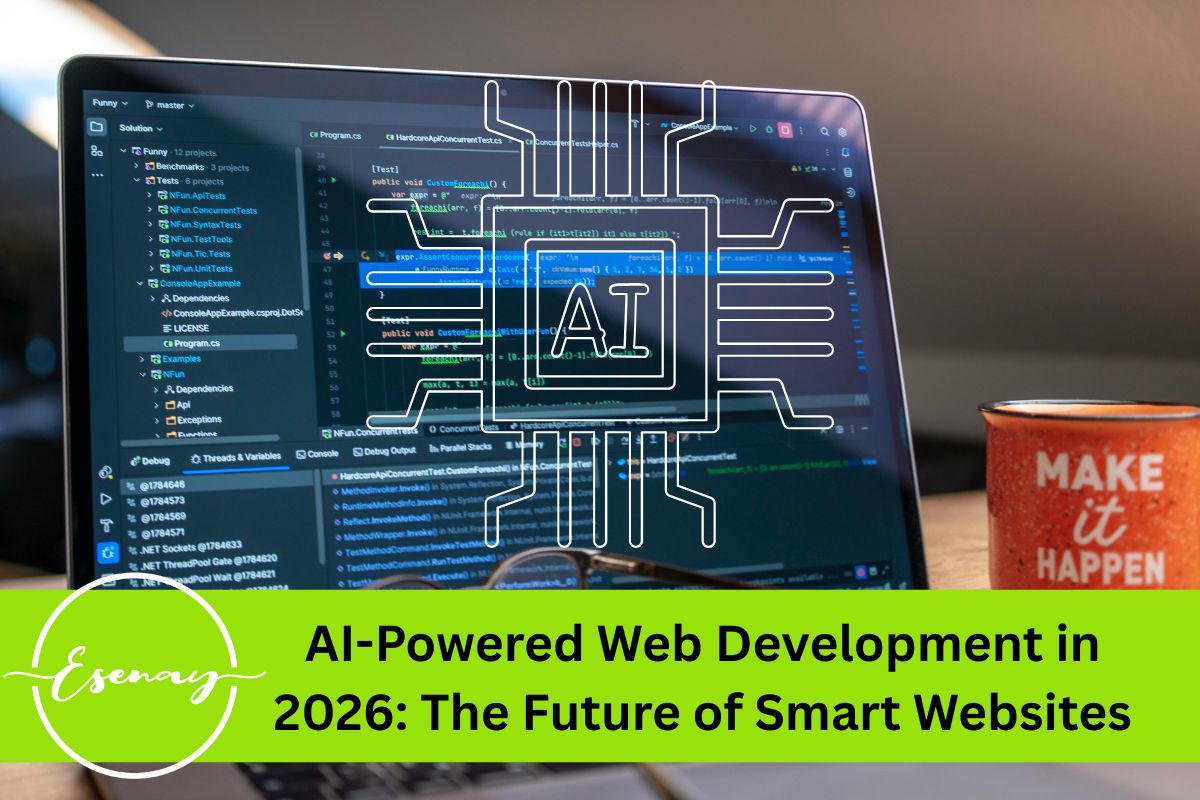
The most visible transformation in 2026 web development is how code is written. AI coding assistants – tools like GitHub Copilot, Cursor, and Claude Code – no longer just autocomplete snippets. They architect entire components, suggest optimal database schemas, write tests, and even refactor legacy codebases automatically.
Autonomous development agents take this further. Given a product requirement in plain English, these agents can scaffold a full-stack application, configure deployment pipelines, and flag security vulnerabilities – all before a human developer reviews the first pull request.
Developer insight: This doesn’t mean developers are obsolete. Rather, their role has evolved into orchestrators – defining intent, reviewing AI outputs, and applying judgment where context and creativity matter most.
Hyper-personalization at scale
Static websites are a relic of the past. In 2026, smart websites use real-time machine learning models to adapt content, layout, call-to-actions, and even pricing – dynamically – based on who is visiting and what they need.
This goes beyond simple A/B testing. AI-driven personalization engines analyze behavioral signals, purchase history, geolocation, device type, and even time-of-day patterns to compose a unique experience for every user at the moment they land on a page. E-commerce platforms using this technology report conversion rate improvements of 30–50% compared to static counterparts.
What hyper-personalization looks like in practice
A returning visitor from a mobile device in the evening might see a simplified layout with dark mode enabled by default and a prominent “continue where you left off” prompt. A first-time desktop visitor from a corporate IP address sees a different hero message, formal tone, and an enterprise-focused CTA – all generated live, without manual segmentation.
Conversational interfaces and AI agents
The standard website navigation menu is being replaced – or at minimum, supplemented – by conversational AI interfaces. In 2026, users increasingly expect to simply ask a website what they need rather than click through pages to find it.
Embedded AI agents handle everything from product discovery and support queries to booking flows and complex multi-step transactions. Unlike the scripted chatbots of the previous decade, these agents have deep contextual awareness of the entire website, the user’s history, and current inventory or availability data.
Search engines and AI answer engines (like Perplexity and Google’s AI Mode) now surface content from websites that structure information conversationally. Optimizing for Answer Engine Optimization (AEO) – structuring your content to be directly cited in AI-generated responses – is as critical as traditional SEO in 2026.
Intelligent performance optimization
AI doesn’t just improve what users see – it continuously improves how fast and reliably they see it. Intelligent performance systems monitor Core Web Vitals in real time and make autonomous adjustments: deferring non-critical scripts, preloading assets for predicted next pages, dynamically scaling CDN resources during traffic spikes, and compressing images to the optimal format per device.
The result is websites that self-tune. Page speed scores that previously required weeks of manual optimization are now maintained automatically, with AI catching regressions before they ever reach production.
Security and ethical AI in web development
With greater AI capability comes greater responsibility. AI-powered security tools now scan codebases continuously for vulnerabilities, monitor live traffic for anomalous patterns, and autonomously patch certain classes of known exploits.
Equally important is the ethics layer. In 2026, responsible web development requires transparency about how AI personalizes content, clear data usage policies, and mechanisms for users to understand or opt out of AI-driven experiences. Regulatory frameworks across the EU, India, and the US have codified many of these requirements, making ethical AI not just a best practice but a legal obligation.
What this means for your business
Whether you’re a startup or an enterprise, the competitive divide between AI-powered websites and traditional ones is widening. Businesses investing in AI-driven web experiences see measurably higher engagement, better conversion, and lower operational costs from automation.
The entry barrier, however, is lower than ever. AI development platforms, no-code AI website builders, and accessible APIs mean that even small teams can deploy smart websites that would have required a large engineering department just three years ago.
The question is no longer “should my website use AI?” – it’s “how quickly can we build it right?”
Your business deserves a website that works as hard as you do
Reading about AI-powered web development is one thing – actually having it built for your business is another. At Esenay Digital, we don’t just design websites; we build intelligent, high-performance digital experiences engineered to convert visitors into customers. From custom AI-integrated builds to lightning-fast, SEO-optimised websites tailored to your brand – our website development services are designed for businesses that refuse to be invisible online. Whether you’re launching fresh or overhauling an outdated site, our team delivers results that are measurable, scalable, and built for 2026 and beyond.
Frequently asked questions
What is AI-powered web development?
AI-powered web development uses artificial intelligence tools and models to automate coding, personalize user experiences, optimize performance, and enhance security throughout the web development lifecycle.
How does AI personalization work on websites?
AI personalization engines analyze real-time behavioral data, user history, and contextual signals to dynamically adapt content, layout, and calls-to-action for each individual visitor without manual segmentation.
What is AEO and why does it matter in 2026?
Answer Engine Optimization (AEO) is the practice of structuring website content so it can be accurately cited by AI-powered answer engines like Perplexity or Google AI Mode. As more users get answers directly from AI instead of clicking links, AEO is critical for online visibility.
Will AI replace web developers?
No. AI changes the role of developers from writing every line of code to directing, reviewing, and improving AI-generated outputs. Creativity, architectural judgment, and product thinking remain distinctly human strengths.
How can small businesses afford AI-powered websites?
In 2026, AI website builders, accessible APIs, and no-code platforms make intelligent web experiences affordable even for small teams, with many tools offering usage-based pricing that scales with actual need.